Modern Slavery and Human Trafficking Statement

Introduction from the CEO
Modern Slavery continues to be a priority for the PenCarrie Group to ensure that we trade ethically, source responsibly and work to prevent modern slavery and human trafficking throughout our organisation and in our supply chain.
We, PenCarrie Limited, are committed to improving our practices to combat slavery and human trafficking in our business and supply chain. We expect our entire supply chain to have a zero-tolerance approach to slavery and human trafficking.
This constitutes PenCarrie Limited’s (“PenCarrie”) Modern Slavery statement for the 2025 financial year.
Our Corporate Structure
PenCarrie Holdings Limited is the parent company (which does not trade) and PenCarrie Limited and PenCarrie Ireland Limited are the trading entities (together the “PenCarrie Group”).
PenCarrie Limited and PenCarrie Holdings Limited operate at the following location:
PenCarrie House
South View Estate
Willand
Devon
EX15 2QW
PenCarrie Ireland Limited operates at the following location:
The Liffey Trust Centre
117-126 Sheriff Street Upper
Dublin 1
Ireland
The vast majority of our operations are in the United Kingdom where we have around 300 employees. PenCarrie Limited has an annual turnover of approximately £115 million.
PenCarrie Ireland Limited had not begun trading prior to the end of the 2025 financial year and therefore has nothing to disclose.
Our Business
Our business is primarily structured around third-party distribution with a small amount of own brand distribution.
PenCarrie 3rd Party Distribution
PenCarrie is a leading business to business wholesale clothing and accessory distributor for decoration and resale. PenCarrie holds 3,600 styles and 84,000 SKUs in stock. Our distribution network serves businesses in every corner of the United Kingdom and Ireland from its Willand-based warehouse and, to a more limited extent, across the rest of the EU.
PenCarrie Own Brand
A subsection of PenCarrie’s business is its own brand development of clothing and accessories for distribution.
Our Supply Chain
PenCarrie recognises that it is crucial for us as an organisation to have oversight of our supply chains so that we can understand the risks of modern slavery along the chain and take action to mitigate against those risks. This year we have focused on how we can monitor and continually improve this.
We have approximately 23 active Goods For Resale (“GFR”) product suppliers who manage the sourcing and manufacture of promotional and corporate clothing and accessory products. These suppliers are integral to our product distribution, ranging from long-standing partners, some of whom we have worked with for 35 years, while more recently acquired suppliers are expected to provide information on ethical trading and manufacturing processes. We make available all our GFR brands’ manufacturing accreditations, ethical trading policies and statements and sign-post their sustainability information on our website.
PenCarrie’s purchases from brand suppliers based in the UK, mainland Europe and the USA incorporate the vast majority of our supply chain. The majority of these suppliers manufacture in Bangladesh, Pakistan, India, China, Morocco and South America. All product items purchased by PenCarrie are for distribution to garment decorators and other on-sellers, primarily in the UK.
We have approximately 570 active suppliers which we categorise as ‘Goods Not For Resale (“GNFR”) suppliers who assist the business through the provision of services and direct goods not directly linked to our product distribution. While these suppliers may present different risk levels, we are committed to extending our modern slavery risk assessments and ethical standards across all supplier categories.
PenCarrie’s Own Brand products are predominantly purchased from six suppliers across India, China and Bangladesh.
For our Labour supply chain, we recognise that risk of modern slavery can exist at any stage of our supply chain and in the recruitment and employment of labour. Our commitment is to ensure that all team members working directly for PenCarrie are treated fairly, ethically and with respect for their human rights.
Our key modern slavery risk areas include (i) overseas garment manufacturing in higher-risk jurisdictions, (ii) multi-tier supply chains where visibility is limited, and (iii) labour practices within logistics and recruitment.
Modern slavery risk management governance
The PenCarrie Board is committed to ensuring all employees are aware of the risks of modern slavery. Although ultimate responsibility for Modern Slavery Act compliance sits with the Board, the Interim People and Culture Director has day-to-day management of modern slavery risk. The Leadership structure has strong lines of communication, risk awareness and accountability of which our modern slavery processes benefit. PenCarrie expects employees in relevant roles to identify, assess and respond to modern slavery risks as part of their responsibilities and to escalate concerns where appropriate.
Continuous improvement of operations and supply chain knowledge
We have undertaken, during this financial year, to combat modern slavery in our organisation and supply chain. Acting on the output of our ESG consultation and assessment, we have progressed multiple actions to further improve our supply chain knowledge and due diligence, including but not limited to:
(i) Creation of a new section on our website www.pencarrie.com/our-responsibility dedicated to ‘Responsibility’; a central place to share our activities, progress and updates and improve transparency for all stakeholders across four pillars: our product, our people, our planet and our community. The implementation of the strategy, including strengthening PenCarrie’s corporate governance structure with respect to ESG and confirming our ambition, from which to develop clear goals and targets to work towards in future.
(ii) Development of a GFR Supplier Code of Conduct to be rolled out across all current suppliers and used to assess and onboard new suppliers, making clear our expectations in a more formal way.
(iii) Rolled out Modern Slavery training to key employees in relevant risk areas;
(iv) Continued to elevate risk management and accountability, with the creation of a risk register and regular review opportunities for all Leadership and the Board; and
(v) Annually, we receive and review brand supplier ethical trading policies, encouraging our suppliers to continually improve the information supplied, which is then published on our website. We are actively working on improving access to GFR Supplier sustainability information by utilising digital enhancements to link to critical relevant information.
To support the measurement of our progress, we plan to develop KPIs and will report against these in future statements as our approach matures.
We will continue to improve supplier due diligence and contract management processes, ensuring that new procedures are effectively embedded across the business into everyday use with continuous training.
Due Diligence Processes for Modern Slavery and Human Trafficking
With respect to our Own Brand suppliers, we ask all new manufacturing partners to adhere to our Own Brand Code of Conduct before we begin working with them. The Own Brand Code of Conduct sets out the high standards of labour practices and ethical business conduct we expect. This includes, but is not limited to:
- Rejecting the use of any forced or child labour or any workplace discrimination against any worker
- Protecting the rights of all workers to fair and legal working hours, pay, benefits and disciplinary actions
- Ensuring all workers have Freedom of Association and Collective Bargaining rights.
In our Own Brand operations, we are in a position of transitioning to ensuring every factory we use has been independently audited to an ISO9001 level, which also includes an ethical audit to highlight risks of modern slavery and human trafficking.
We have the following due diligence processes in place to help make sure we are tackling slavery and human trafficking risks in our third-party distribution supply chains:
- We make extensive enquiries around sustainability and manufacturing processes when considering new apparel product suppliers. We also regularly review our existing product suppliers’ policies on modern slavery and other areas of their operations.
- We place particular reliance on the certifications and trade bodies such as SEDEX, WRAP and Fair Wear Foundation of which many of the brands we represent are members. They are responsible for auditing the brands’ supply chains and we use these credentials as part of our supplier assessment process.
- Each of our brands supplies us with an official Ethical Trading Statement/Policy, which can be found on the individual brand library pages on our website.
- We build long-standing relationships with our suppliers, and we make clear our expectations of business behaviour.
- We expect each supplier in the supply chain to, at least, adopt ‘one-up’ due diligence on the next link in the chain. Unfortunately, it’s not practical for us (and every other participant in the chain) to have a direct relationship with all links in the supply chain.
- Additional, often more detailed information is available on the brands’ own websites.
Where risks are identified, we work with suppliers to address concerns, which may include corrective action plans and, where appropriate, the ability to terminate relationships where standards are not met.
Our policies on Modern slavery and human trafficking
We aim to have appropriate policies in place that underpin our commitment to ensure that there is no modern slavery or human trafficking in our supply chains or in any part of our business. We annually review and update all our policies.
Our Modern Slavery Policy reflects our commitment to acting ethically and with integrity in all our business relationships and to implementing and enforcing effective systems and controls aiming to ensure slavery and human trafficking is not taking place in our supply chains. We also have the following policies in place relevant to modern slavery, which we continuously review and update:
- Own brand Code of Conduct.
- Whistleblowing Policy.
- Modern Slavery Policy.
- Anti-Bribery and Corruption Policy.
In addition, we have a robust recruitment policy and process which ensures against the recruitment of child labour. This is supported through a structured application and interview process as well as pre-employment checks.
Training
To ensure a high level of understanding of the risks of modern slavery and human trafficking in our supply chains and our business, we provide training to our staff.
This year, Modern Slavery training has been provided to all key employees who engage with our product and non-product suppliers, recruitment and procurement staff. The content of the training highlighted the various types of modern slavery and employees were tested on their modern slavery knowledge afterwards.
In the next year, we will expand the number of employees who receive training and increase our company-wide awareness-raising campaigns.
Further steps
Following a review of the effectiveness of the actions we have taken this year to combat the risk of slavery and human trafficking in our business and supply chains, we intend to review the following further steps in line with our commitment to continually improve and strengthen our approach year-on-year:
- Implement recommendations from our ESG consultant and strengthen our corporate governance approach.
- Undertake further risk assessment and review of due diligence procedures on our GFR suppliers.
We will engage with various stakeholders to inform both the development and implementation of modern slavery policies.
Board Approval and Publication
This statement is made pursuant to section 54(1) of the Modern Slavery Act 2015 and constitutes our slavery and human trafficking statement for the financial year ending 31 Dec 2025. It was approved by the board on 14 August 2026.
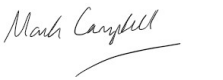
Signed by:
Mark Campbell,
CEO PenCarrie Limited
Date:14/8/26